Where I Stand on AI in Video Production
Prefer to watch instead of read? Here’s the full breakdown on YouTube:
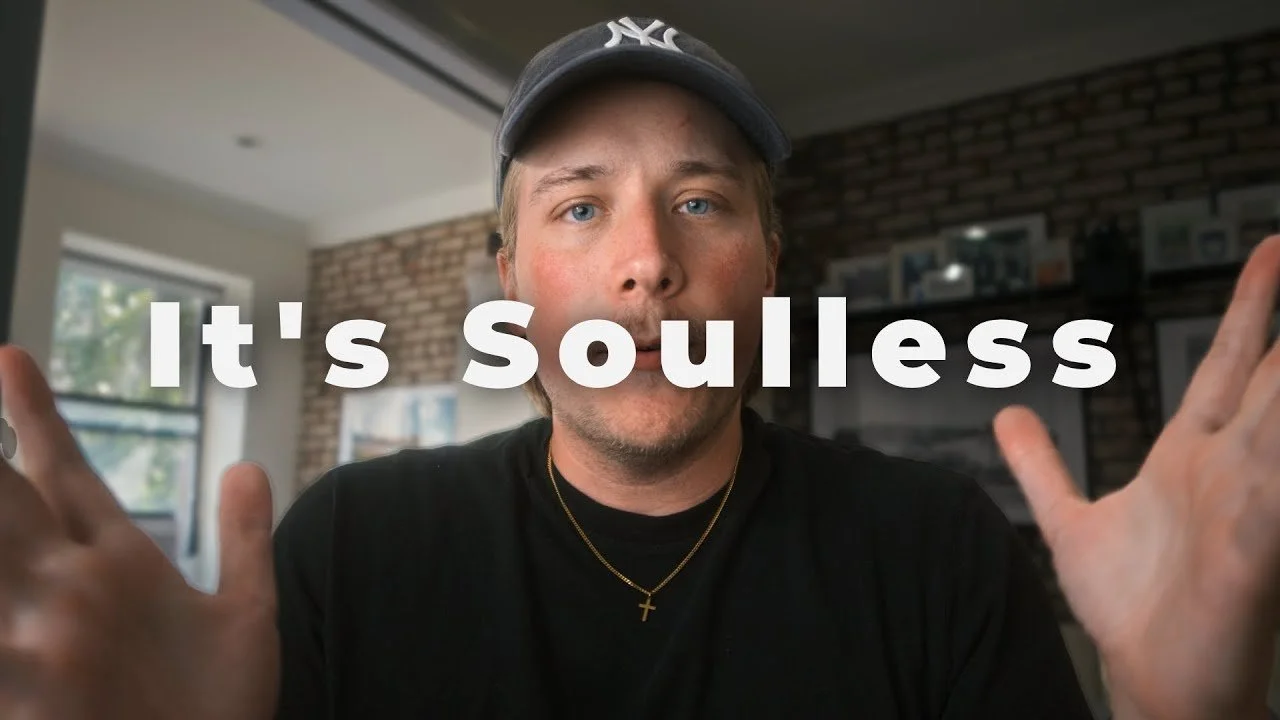
I want to have a real conversation about where AI fits into video production right now, because I think the conversation has gotten too polarized in either direction.
I run a video production company in New York City. I've been doing this full time for about five years, alongside building this channel. And I'll say upfront — I'm a fan of AI as a tool. I use Claude on a daily basis to help run my business. I use AI-based editing tools. I've used AI to clean up footage I've already shot, removing objects and fixing things that would otherwise take hours of manual masking work.
So this isn't a doom and gloom take. It's a line I've drawn, and I think it's worth explaining why.
The Line I Draw
Here's my actual position: if you're using AI as a tool inside a human-led creative process, I'm fine with it. Cleaning up an image. Generating a rough storyboard if you're not a skilled illustrator. Speeding up tasks that used to take longer with traditional tools. None of that replaces a human creative vision — it just removes friction from executing it.
What I have a real problem with is AI replacing the final deliverable entirely. And more specifically, I have a problem with the companies making that happen.
What's Actually Happening With Stock Media Companies
As someone who was a music major before running a production company, this part hits close to home.
A number of stock footage and stock music companies built their entire business on the backs of real artists and creators submitting work to their libraries. Those companies have now trained AI models on that same catalog — the work of the artists who built their platform — and are using it to generate new content that cuts those same artists out entirely.
That's not innovation. That's using the people who built your business to eliminate the need for the people who built your business.
Why This Matters for Your Clients Too
There's a transparency issue here that doesn't get talked about enough.
I've had a client come to me recently who had previously been sold a video by another provider, told it was created by a full production team, when it turned out to be entirely AI generated. Beyond the ethical problem, there's a practical one — if you're running ads against content and it wasn't disclosed or created within a particular platform's approved AI framework, it can actually hurt ad performance.
If you're using generative AI and selling that work directly to clients, be transparent about it. That's not optional.
What I'm Doing About It
I've been affiliated with a couple of these stock media companies. Once my current subscriptions lapse, I'm done. I've already moved my music sourcing over to a provider that guarantees they only work with real human musicians — they use AI for search and music discovery, which is a legitimate use case, but never for generating the actual music itself.
For anyone looking for alternatives, here's how I'd rank the landscape:
Musicbed is the gold standard. They pay their artists the highest rates and are strictly human-created. They're also the most expensive, which isn't accessible for every budget.
Epidemic Sound has been a reliable, long-standing option that has committed to staying human-made.
The provider I've personally partnered with going forward offers a solid middle ground — monthly, yearly, and even lifetime subscription options, with a full commitment to human-created music.
The Bigger Picture
I think part of why we're seeing a cultural pull back toward analog and tactile media — digital cameras with character, film, IMAX, 70mm — is precisely because of this moment. People want to feel human achievement behind what they're watching and listening to. AI can generate something technically impressive, but it's missing that.
If you're working with tighter budgets, and I work with plenty of clients who are, supporting real artists in your music and footage sourcing is not the expensive choice people assume it is. It just takes the awareness to seek it out intentionally.
Budget for real creative talent wherever you can — a storyboard artist, a second camera operator, a motion graphics designer. If a low budget situation genuinely requires a shortcut, that's understandable. But it should never be the final deliverable sold to a client as fully human-made work when it isn't.
Support real creators. It costs less than most people think, and it makes the entire industry sustainable for everyone in it — including you.
If you want to see my full breakdown, the full video is available HERE